
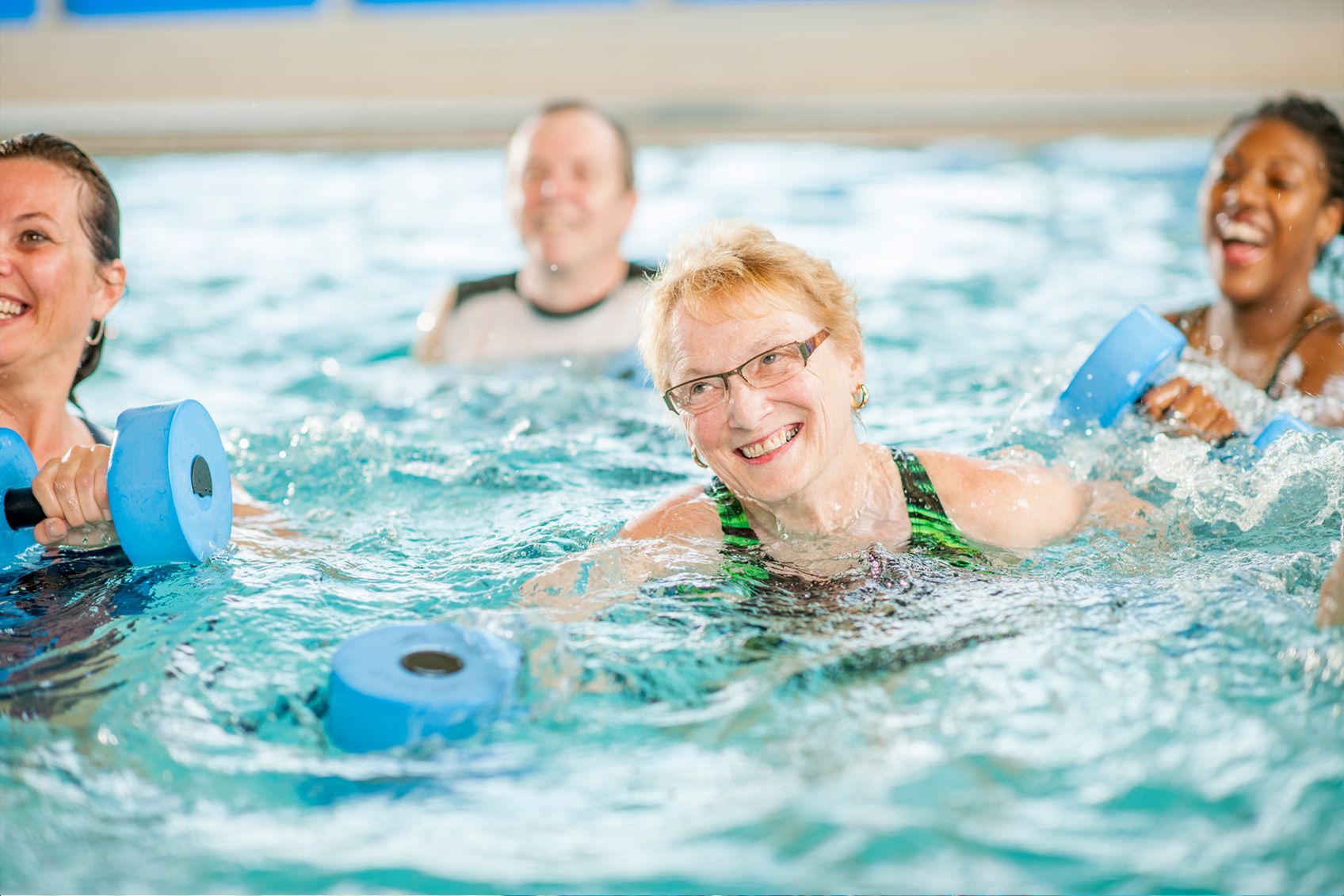
Osteoarthritis, which is often referred to as degenerative joint disease (Arden 16) is a condition in which the cartilage tissue attached at the end of a person’s bones begin to wear down gradually, worsening over time (Arden 14). There is an increased risk of getting this if you work in a physically demanding job \that often puts pressure on your joints. While it can affect any joint, the most common target area are the hands, hips, spine, and knee (Riebe et al. 388). Symptoms include stiffness in the affected joint, especially after being stationary for a long period of time (such as after sleeping). A person can also experience swelling or tenderness in the joint (Arden 15). There is no known cure for this disease, however, there are ways that a person can manage the pain, Aquacize being a popular option.
There are a number benefits for a person with osteoarthritis to exercise in water. For instance, most individuals with osteoarthritis have edema (swelling at a certain part of the body). Because of water’s pressure properties, having certain parts of the body underwater decreases effect of swelling. Underwater, the force exerted on the body is slightly greater than diastolic blood pressure in a person’s body (Gangaway 87). Because of the hydrostatic force, there is a reduction in swelling. Another potential benefits to individuals with osteoarthritis is using the water's buoyancy properties. When a person is on land, gravity is pushing a person down on their joints. For some individuals, this creates a compressive stress on joints, which is damaging to joint health. The water's buoyancy helps cancel certain part of this gravitational pull and can lead to a decreased compressive stress on joints. For instance, if a person is standing at waist level depth in a pool, 50% of the body weight is offloaded because of the buoyancy force (Gangaway 87). This means that there is 50% less pressure than there would be if you were on land. This allows a person to be on their feet and exercise without that much force as they would have on land based exercises.
Studies have shown that aquatic based exercises can be more beneficial for individuals with osteoarthritis than land based ones. In one study, men that were over 50 years old who suffered from knee osteoarthritis were placed in an aquatic exercise therapy program. The program was carried out a total of 3 times per week for a total of 6 weeks. Over the course of the program, several different factors were measured by the participant’s own scores. The individual that participated in the program stated that there was a reduction in pain felt and reductions in other symptoms common to osteoarthritis, such as swelling and stiffness (Soleyman et al. 33). The participants also stated that they had better performance in daily activities, such as going up the stairs. Other studies have also found that that aquatic based exercise can reduce pain for individuals with osteoarthritis (Kim et al. 181), (Stover et al. 13). Aquatic exercise holds potential for being a great exercise program for individuals with osteoarthritis.
References
Arden, E., et al. Osteoarthritis. [Electronic Resource]. Oxford ; New York : Oxford University Press, 2008., 2008. Facts. EBSCOhost, https://login.proxy.libraries.rutgers.edu/login?url=https://search.ebscohost.com/login.aspx?direct=true&db=cat05280a&AN=rutebrary.ebr10581633&site=eds-live.
Gangaway, JMK. "Older Adults: The Need for Exercise and the Benefits of Aquatics." Topics in Geriatric Rehabilitation, vol. 26, no. 2, Apr-Jun2010, pp. 82-92. EBSCOhost, https://login.proxy.libraries.rutgers.edu/login?url=https://search.ebscohost.com/login.aspx?direct=true&db=c8h&AN=105022176&site=eds-live.
Kim, In-Sook, et al. "Original Article: The Effectiveness of an Aquarobic Exercise Program for Patients with Osteoarthritis." Applied Nursing Research, vol. 25, 01 Aug. 2012, pp. 181-189. EBSCOhost, doi:10.1016/j.apnr.2010.10.001.
Riebe, Deborah, Jonathan K. Ehrman, Gary Liguori, and Meir Magal. Acsm's Guidelines for Exercise Testing and Prescription. , 2018. Print.
Soleyman, Ansari, et al. "Effects of Aquatic Exercise Training on Pain, Symptoms, Motor Performance, and Quality of Life of Older Males with Knee Osteoarthritis." Annals of Applied Sport Science, Vol 2, Iss 2, Pp 29-38 (2014), no. 2, 2014, p. 29. EBSCOhost, https://login.proxy.libraries.rutgers.edu/login?url=https://search.ebscohost.com/login.aspx?direct=true&db=edsdoj&AN=edsdoj.b3a788b3d9b451f8e148ea74c42111f&site=eds-live.
Stover, Alexandra, et al. "Aquatic Exercise for Pain Reduction in the Active Adult with Osteoarthritis." Journal of Aquatic Physical Therapy, vol. 23, no. 2, Summer2015, pp. 13-19. EBSCOhost, https://login.proxy.libraries.rutgers.edu/login?url=https://search.ebscohost.com/login.aspx?direct=true&db=c8h&AN=109039681&site=eds-live.